
3 Must-Try Chinese New Year Steamboat Recipes with a TCM twist
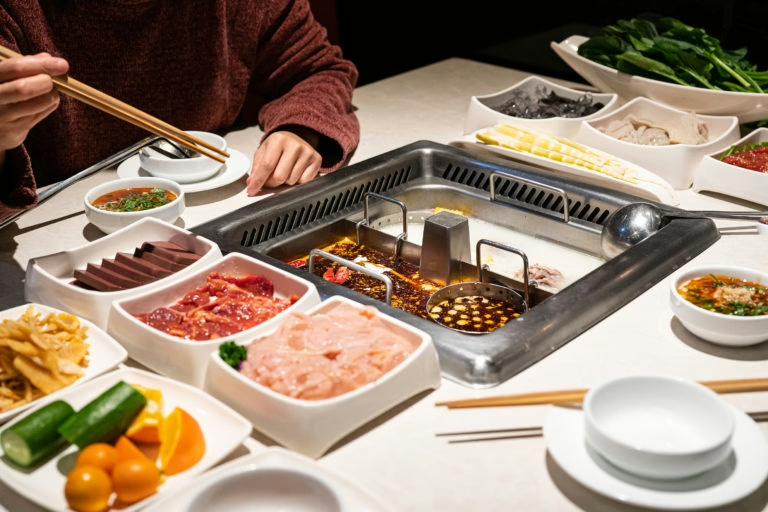
Link copied! Assembled with a pot of simmering hot broth and a table full of fresh delectable ingredients, steamboat, also known as hotpot (火锅) is a must-have dish at almost every reunion dinner. However, do you know that there are many ways to have this mouthwatering dish in a nutritious and healthy manner, yet not compromising on the flavour at the same time? Chinese steamboat was thought to have hailed from Eastern China about more than 1000 years to the time of the Jin Dynasty. It was believed to originate from Mongolia whereby the Mongolian horsemen used their helmets as pots to boil their broths over a fire and enjoy a spread of different types of meat together. This warm and hearty dish brought many together and subsequently spread throughout China where different regions came up with their own versions that were brought forward even to this day. This seemingly healthy popular Asian dish is however not as healthy as we may perceive it to be. According to a research in Mt. Alvernia Hospital, a dietician has found that conventional hotpot bases exceed 7000mg of sodium per serving, while the recommended amount of sodium that we should be consuming each day would be 1500mg. [1] Furthermore, we often add a variety of processed meat, such as meatballs, luncheon meat and sausages which are also high in sodium. The excessive intake of such food can potentially increase the risk of developing conditions such as high blood pressure, stroke and heart conditions as well. Also read Prevent And Treat The 3-Highs With TCM Tips for a healthier steamboat In Singapore, steamboat is widely enjoyed and loved by people of all ages. It is also consumed frequently, not only during reunion dinners during the Lunar New Year. Here are some useful tips to create a healthier steamboat meal that even the elderly and young ones can enjoy heartily without compromising on their health. Reduce intake of high-sodium food from processed meat and store-bought soup bases as a high intake of such food can potentially lead to health concerns such as high blood pressure, kidney conditions etc. Substitute heavy carbohydrates with green leafy vegetables or other healthier choices such as sweet potato, Chinese yam (Shan yao). A heavy carbohydrate diet is not ideal for individuals with chronic conditions such as diabetes and those who are trying to control their calorie intake. In addition, overeating also harms the Spleen, which can impede digestion and cause some harm to the digestive system. It is important to know what you are putting into your body as TCM believes that diet plays an important role in helping to build up a person’s body constitution. A diet high in sodium and carbohydrates would bring about a series of health conditions such as high blood pressure, high cholesterol and high sugar levels that could lead to detrimental diseases in the long run. Pro-tip for Mala and Tomyum soup lovers: Try pairing your meal with Chrysanthemum Goji Berry tea or fresh mint honey tea instead of soda or alcoholic drinks. Read more Combat Festive Overeating With This Essential TCM Guide 3 Family-friendly TCM soup recipes to try this year 1. Qi and Blood nourishing soup base (养生补血锅底) Ingredients: 1 Small free-range chicken 10g of Dang Gui 当归 (Angelica sinensis) 15g of Dang Shen 党参 (Codonopsis radix) 5 Red dates 红枣 2 Slices of Ginger 生姜片 Directions: Wash and drain all the dried herbs to remove any dirt before placing them in a teabag for easy removal. Place all ingredients in a large pot and add about 7 cups of water. Simmer under medium-low heat for about 1 hour and 30 minutes and remove the chicken when the meat is tender and fully cooked. Shred and set the chicken meat aside for adding to the steamboat. 2. Chicken soup base (鸡肉清汤火锅底) Ingredients: Half a kampong chicken 土鸡半只 1 Carrot 胡萝卜 1 Fresh corn 玉米 2 Slices of Ginger 生姜片 A pinch of salt 盐 Spring onion as desired 葱 Directions: Place all ingredients in a large pot and add about 7 cups of water. Simmer under medium-low heat for about 1 hour and 30 minutes and remove the chicken when the meat is tender and fully cooked. Shred and set the chicken meat aside for adding to the steamboat. Add a pinch of salt and garnish with spring onion as desired. 3. Mushroom soup base (菌菇火锅汤底) Ingredients: 25g Enokitake mushroom 金针菇 25g Shitake mushroom 冬菇 25g Pholiota nameko 滑子菇 2 Slices of Ginger 生姜 1.4kg Pork bones (try to pick the bones with more meat on them) 猪骨头 Spring onion as desired 葱 A pinch of salt 盐 Directions: Soak the pork bones in cold water for at least 1 hour to get rid of any excess grime and blood and drain the water. Place the bones in a large pot and add enough water to cover the bones, then boil for around 10 minutes before draining away all the water. Rinse the bones under cold water. In a large clean pot, place the pork bones, the mushroom and ginger slices and add about 7 cups of water. Leave it to simmer under medium-low heat for 1 hour and 30 minutes Towards the end add a pinch of salt and garnish with spring onions as desired. This article is written by Physician Julie (Oriental Remedies Group, Singapore), a registered TCM physician certified by the Traditional Chinese Medicine Practitioners Board (TCMPB). Julie Low Lead Physician VIEW QUALIFICATIONS Physician Low graduated from the double degree programme of Biomedical Sciences and Traditional Chinese Medicine at NTU in 2014 and was awarded with the Chinese Government Scholarship for outstanding academic achievements during her time in Beijing. She has been in active practice since graduation, treating patients with various ailments such as pain management, gastrointestinal issues, holistic weight loss management, etc. Through her years of practice, she has developed strong interest in paediatric care. As a mother herself, she understands the anxiety of a parent and
Prevent and Treat The 3-Highs With TCM | High Blood Pressure, Cholesterol, Diabetes

In Mandarin, the 3-Highs, otherwise known as San Gao (三高), is an umbrella term that refers to 3 commonly seen metabolic disorders known as Hypertension – high blood pressure (HBP) (高血压), Hyperlipidemia – high triglycerides (HTG) (高脂血症) and Hyperglycemia – high blood glucose (HBG) (高血糖血症). The 3-Highs are technically not TCM terms but rather the Mandarin translation for a group of 3 metabolic conditions commonly described in western medicine. Constantly elevated blood glucose that is not well-controlled can eventually lead to diabetes, which brings a host of complications that can lead to kidney problems, eye diseases, foot damage and numbness. Uncontrolled blood pressure is a risk factor for stroke and ischemic heart disease [1][2], while high triglycerides (colloquially known as high cholesterol) in the blood can cause hardening of the arteries which similarly leads to increased risk of stroke, heart attack and heart disease [3]. So now that we know what are 3-Highs and their effects, let’s understand the common causes of these common conditions: 3 Highs Common Causes Other causes Hypertension(High Blood Pressure) Stress Lack of physical activity Family history of the disorder Obesity/being overweight Diet high in salt, fat, and/or cholesterol Genetics Aging Certain medicine e.g. birth control pills Smoking or drinking too much alcohol Hyperglycemia(High Blood Glucose) Illnesses, such as colds Overeating/Over snacking between meals Certain medicines, such as steroids Hyperlipidemia(High Triglycerides) Smoking Drinking too much alcohol Eating foods high in saturated fats/trans fats In TCM, the 3-Highs are seen as symptoms and expressions of a disease or Syndrome. For instance, an individual with Liver-Fire uprising Syndrome would often present with hypertension; high blood glucose is often seen in people who have Xiao Ke Bing; high triglycerides are commonly found in individuals who fit into the Phlegm-Dampness Syndrome. Of course, these are generalisations and one should avoid self-diagnosis in the absence of a trained TCM physician. Hence, when it comes to TCM treatments, the root cause is always the target of the treatment. With successful treatments, not only will the 3-Highs be resolved but also the other symptoms and expressions that come with it. With that being said, how can TCM help alleviate symptoms of the 3-Highs? Using TCM herbs to prevent and manage the 3-Highs 1) Home remedies – TCM herbal tea a. Chrysanthemum for hypertension Ingredients: Chrysanthemum (3-5g per person) Directions: See notes below Effects: Dispel Wind and Heat, calm the Liver and improve eyesight, clear away Heat and detoxify body. Modern medical research has shown that chrysanthemum has anti-inflammatory properties, is able to dilate coronary arteries and increase coronary blood flow thereby lowering blood pressure[4]. For a blood pressure-lowering tea, this herb is often paired with Chinese Senna (Jue Ming Zi 决明子)and Prunella vulgaris (Xia Ku Cao 夏枯草). b. Mulberry leaves for hyperglycemia Ingredients: Mulberry Leaves (5-10g per person) Directions: See notes below Effects: Evacuate Wind and Heat, relieve the Exterior and clear away Heat, nourish Yin and promote fluid production. Modern medical research mentioned that mulberry leaf extracts have blood sugar-lowering effects[5]. Mulberry leaf is usually added to Cinnamon bark (Rou Gui 肉桂)and Solomonseal Rhizome (Huang Jing 黄精)for a savoury drink that has blood sugar controlling effects. c. Hawthorn fruit for hyperlipidemia Ingredients: Hawthorn Fruit (5-10g per person) Directions: See notes below Effects: To dissipate stagnation, promote Blood circulation and disperse Blood stasis, resolve Phlegm and move Qi. Modern medical research has suggested that hawthorn fruit extract has a significant benefit in symptom control and physiologic outcomes in the treatment of chronic heart failure[6]. Additionally, it has the ability to help decrease levels of triglycerides[7]. Hawthorn fruit can be combined with Notoginseng flower (San Qi Hua 三七花)and Gynostemma Pentaphyllum (Jiao Gu Lan 绞股蓝)to create a potent triglyceride-lowering beverage. Notes: For individuals with 2 or 3 of these conditions concurrently, the above-mentioned ingredients can be mixed-up and switched around to achieve the same effects. For example, an individual with both hypertension and hyperglycemia can have tea with chrysanthemum, mulberry leaf and Prunella vulgaris which is the famous Xia Sang Ju (夏桑菊) that many Chinese people are acquainted with. The number of ingredients doesn’t matter but for the sake of a tea, we normally keep the number of ingredients at 3 or lower. If you are making tea with 3 herbs for 1 person only, the amount to add is in the range of 1-5g per herb. Multiply the amount by the number of people sharing the drink accordingly. In summary, these drinks can be drunk safely over the course of a few weeks to a few months*. However, if you do not see any improvements in the conditions after 3 months of consumption, do seek a trained physician or doctor to manage them properly*. *Not suitable for pregnant women, individuals suffering from fever, patients with severe cases and individuals under medication. 2) Lifestyle and dietary changes Regardless of the treatments one does, it is always of great importance to also control what we consume in our diets. After all, this trio of metabolic conditions commonly arises from an imbalanced diet. A healthy diet high in fibre and minerals while low in processed food and salt can help to stave off the 3-Highs by slowing down the rate of absorption of glucose, while maintaining the right balance of nutrients for our body. Foods high in fibre include pumpkin, sweet potatoes and radish while minerals can be obtained from fresh fruits, vegetables or supplements. Avoid food that comes in a can as these usually contain more preservatives and additives that can be inflammatory to our body. Chronic inflammation has been known to be associated with increased risk of heart disease or stroke for 20 years, but new studies show that reducing inflammation can lower the likelihood of subsequent heart attacks or strokes by 15%[8]. Maintaining an active lifestyle is also essential for preventing and even reversing the 3-Highs. Exercise helps improve blood circulation, helps our body detox and destress, and releases endorphins – “feel good” hormones that help improve our mood and help us relax.
