Why You Feel Extra Tired Before Your Period
29 June, 2026
Key Takeaways
- Feeling tired before your period? Premenstrual fatigue happens when the body shifts Qi and blood flow to prepare for menstruation, which may lead to lower energy levels and increased tiredness.
- Qi is directed towards the uterus, leaving less available for the brain and muscles.
- Stress, poor sleep, and weak digestion can significantly worsen fatigue before your period.
- Different imbalances in the body can show up in different ways, and these patterns help guide personalised care.
- Traditional Chinese Medicine (TCM) treatments, such as herbal medicine and Acupuncture, can be adjusted across the menstrual cycle to support premenstrual fatigue, replenish energy and help make period-related symptoms more manageable.
It is common to feel noticeably more drained in the days leading up to your period, even when your routine, sleep, and diet have not changed. Many women describe feeling tired before their period without a clear reason, which can be frustrating or confusing.
This experience, known as premenstrual fatigue, is often a reflection of how the body shifts its internal resources to prepare for menstruation. While this change is natural, the intensity of fatigue can vary depending on your baseline energy, stress levels, and overall health.
In this article, we explore what causes this fatigue from a TCM perspective, what happens to the body during this phase, and how TCM can support your energy and recovery.
What Happens in the Body Before Your Period?
In TCM, premenstrual fatigue is generally caused by changes in energy distribution.
In the days leading up to menstruation, the body directs Qi (vital energy) and Blood downward to the Chong (Penetrating) and Ren (Conception) meridians to prepare the uterine lining for either implantation or menstrual flow. With more resources concentrated in the lower abdomen, there is less active nourishment available for the brain, muscles, and limbs
For someone with strong reserves, this may feel like a mild dip in energy before the menstrual cycle. However, if the body is already depleted, this shift can feel much more draining.
How Lifestyle Habits Contribute to Imbalances and Fatigue
1. Fatigue from Poor Sleep
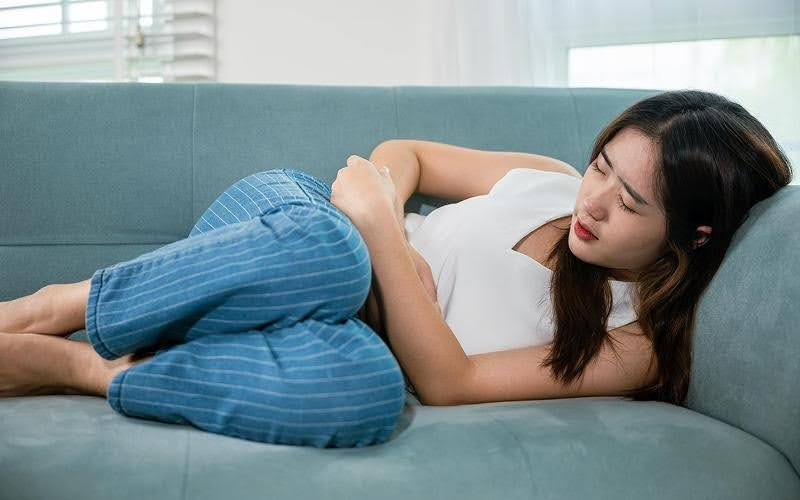
Without deep sleep to repair and rebuild the body’s deep reserves (Yin and Blood), a woman enters the luteal phase already in an energetic deficit. As a result, they may experience symptoms like deep exhaustion, pale complexion, dizziness, poor concentration, lighter menstrual flow, or other menstrual irregularities.
2. Stress-Related Fatigue
3. Low Energy from Poor Digestion
The Spleen plays a central role in converting food into Qi and Blood. When digestion is affected by irregular eating habits, overthinking, or chronic stress, the body struggles to generate enough energy. This can lead to Spleen Qi deficiency, which presents with symptoms like sluggishness, bloating after meals, loose stools, poor appetite, and a heavy feeling in the limbs.
In modern lifestyles, a combination of Liver Qi stagnation and Spleen Qi deficiency is commonly observed. High stress levels disrupt the smooth flow of Qi, while weakened digestion reduces the body’s ability to produce energy.
How TCM Treatments Support Energy Across the Menstrual Cycle
Acupuncture and Herbal Medicine
Acupuncture and herbal medicines are core TCM approaches used to address the underlying causes of premenstrual fatigue in Singapore. Treatment is personalised based on whether the fatigue is driven by deficiency (such as low Qi, Blood, or Yin) or stagnation (such as constrained Liver Qi).
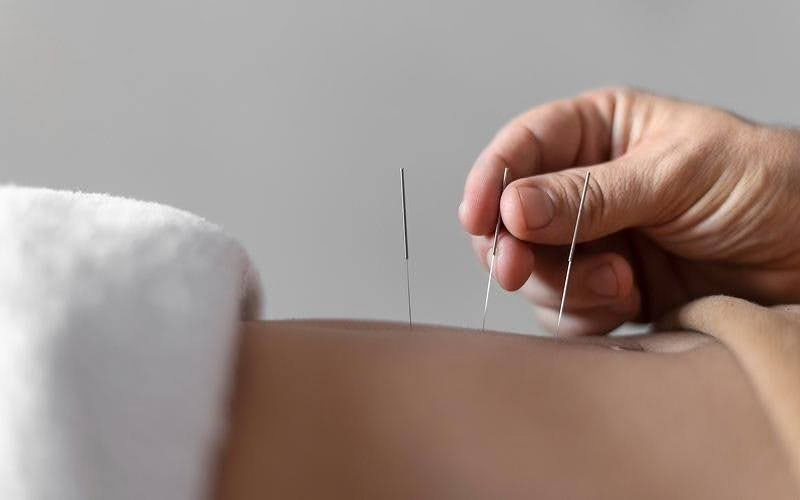
Acupuncture involves the insertion of fine needles at specific points along the body’s meridian. These points are selected to regulate the flow of Qi and Blood, helping to restore smoother circulation, reduce areas of tension, and support more stable energy levels[2]. Over time, this can help reduce the intensity of fatigue and improve how the body adapts across different phases of the menstrual cycle.
Herbal medicine works alongside Acupuncture by providing sustained internal support, and prescriptions are customised to the individual and adjusted over time. For example, herbs such as Dang Gui are commonly used to support Blood nourishment and circulation, while Shu Di Huang helps replenish Yin and restore deeper reserves. These formulations aim to help improve your baseline energy levels, so the premenstrual phase feels less draining.
Electro-Lymphatic Therapy (ELT)
At Oriental Remedies Clinic, ELT is a gentle, non-invasive therapy that uses inert gas ionisation to help stimulate lymphatic flow, encourage detoxification, and support the body’s natural detoxification processes[3].
It is also used to help clear symptoms like bloating, fluid retention[4], and sluggishness, which are often associated with Dampness. By reducing congestion, ELT can help improve how light or energised the body feels in the days leading up to menstruation.
Cell Pro Therapy (CPT)
CPT is another tech-enhanced therapy that delivers a high concentration of negative ions into the body, which can help to reduce oxidative stress and neutralise free radicals. By calming the nervous system[5], this treatment encourages the body to shift from a heightened “fight-or-flight” state into a more restorative “rest-and-digest” mode. This can help calm the mind, improve sleep quality[6], and support deeper recovery.
Over time, better sleep and recovery can reduce the intensity of premenstrual fatigue, especially for individuals whose tiredness is closely linked to poor rest.
Understanding Treatment Timing Across the Cycle
TCM physicians will typically adjust treatment according to the four phases of the menstrual cycle, recognising that the body’s needs shift throughout the month.
1. Menstruation
2. Post-menstruation (Follicular phase)
After menstruation, the body enters a rebuilding phase. Treatment is centred on nourishing Yin and replenishing Blood to restore what has been lost, helping to rebuild energy reserves for the rest of the cycle.
3. Ovulation
During this transition phase, the body shifts from Yin to Yang energy. Treatment aims to support this balance, ensuring smooth hormonal and energetic transitions that help maintain stability in energy and mood.
4. Premenstrual phase (Luteal phase)
In the days leading up to menstruation, the focus is on regulating Qi flow, reducing stagnation, and supporting circulation. This helps ease common symptoms such as fatigue, bloating, and tension while preparing the body for a smoother menstrual flow.
When Premenstrual Fatigue May Need Further Attention
While fatigue before your cycle is relatively common, there are situations where it may not be solely cycle-related. Consider seeking further medical assessment if you experience:
- Fatigue that is severe and does not improve after your period
- Persistent dizziness, shortness of breath, or unusually heavy bleeding
- Sudden or severe pelvic pain
- Ongoing insomnia or unexplained weight changes
These signs may indicate underlying conditions that require additional evaluation alongside holistic care.
Supporting Your Energy, Month After Month
Premenstrual fatigue is often a reflection of how your body is managing its internal resources. While a mild dip in energy can be part of a natural cycle, more intense or persistent fatigue may signal that your body needs additional support.
By understanding how energy is distributed, how lifestyle factors influence recovery, and how personalised care can help regulate these patterns, you can take a more informed approach to managing your cycle.
If fatigue is affecting your daily life, consult a MOH-licensed physician for a more personalised assessment. At Oriental Remedies Clinic, our team takes a holistic, patient-centred approach to understand your unique patterns and support your body across each phase of the cycle. Reach out to us to learn how tailored TCM care can help you better manage your energy month after month.
This article is written by Foo Shan Ju, registered TCM physicians certified by the Traditional Chinese Medicine Practitioners Board (TCMPB).

Foo Shan Ju
Senior Physician
Physician Foo graduated from the double degree programme of Biomedical Sciences and Traditional Chinese Medicine at NTU and was awarded the Nanyang and BUCM Scholarship for her outstanding academic achievements.
Since graduation, Physician Foo has been actively helping patients with injury/pain management, gastrointestinal issues and overall wellness. From her experiences, she has developed a strong interest in fertility, sleep disorders and pain management. Physician Foo firmly believes that every individual’s body constitution and conditions are unique and dedicates herself to crafting a treatment plan that is the most suitable for her patient.
Being passionate about life, she advocates achieving better health through sustainable lifestyle habits and enjoys counselling patients on nutrition, exercises and stretches to include in their daily routine.
Physician Foo believes that Traditional methods can be made better with complementary tech-enhanced therapies and that a combination of both will bring better and faster results to patients.
Note: all words in Italics mentioned henceforth refer to the TCM organ system and not the anatomical organs/terms referenced in Western medicine.
Disclaimer:
The content on this page is for information and educational purposes only. Such medical information may relate to disease, injury, drugs, and other treatments, medical devices, and/or health products. Medical information does not amount to advice, and if advice is needed an appropriate professional help should be sought. The disclaimer asserts that no warranties or representations are given in respect of the medical information and that the website operator should not be held liable if a user suffers any injury or loss after relying upon the medical information
Any devices used for technology-enhanced therapies are intended for use only for general well-being purposes or to encourage or maintain a healthy lifestyle, and is not intended to be used for any medical purpose (such as the detection. diagnosis, monitoring, management or treatment of any medical condition or disease). Any health-related information provided by this device or software should not be treated as medical advice.
References:
[1] Liu, M., Jiang, Y., Wang, X., Liu, Q., & Wu, H. (2017). The Role of Rumination and Stressful Life Events in the Relationship between the Qi Stagnation Constitution and Depression in Women: A Moderated Mediation Model. Evidence-based complementary and alternative medicine : eCAM, 2017, 7605893. https://doi.org/10.1155/2017/7605893
[2] Zhang, J., Cao, L., Wang, Y., Jin, Y., Xiao, X., & Zhang, Q. (2019). Acupuncture for Premenstrual Syndrome at Different Intervention Time: A Systemic Review and Meta-Analysis. Evidence-based complementary and alternative medicine : eCAM, 2019, 6246285. https://doi.org/10.1155/2019/6246285
[3] Semyachkina-Glushkovskaya, O., Postnov, D., Lavrova, A., Fedosov, I., Borisova, E., Nikolenko, V., Penzel, T., Kurths, J., & Tuchin, V. (2020). Biophotonic strategies of measurement and stimulation of the cranial and the extracranial lymphatic drainage function. IEEE Journal of Selected Topics in Quantum Electronics, 27(4), 1–13. https://doi.org/10.1109/jstqe.2020.3045834
[4] https://www.uclahealth.org/news/article/lymphatic-drainage-massage-separating-fact-fiction
[5] Oschman J. L. (2007). Can electrons act as antioxidants? A review and commentary. Journal of alternative and complementary medicine (New York, N.Y.), 13(9), 955–967. https://doi.org/10.1089/acm.2007.7048
[6] 堀口昇. 血中MHPG (3-methoxy-4-hidroxy-phenylethyleneglycol ) と脳波測定によるマイナスイオンのストレス軽減効果の検討. 全国マイナスイオン医学会誌. 2000; 4(1): 82-88.